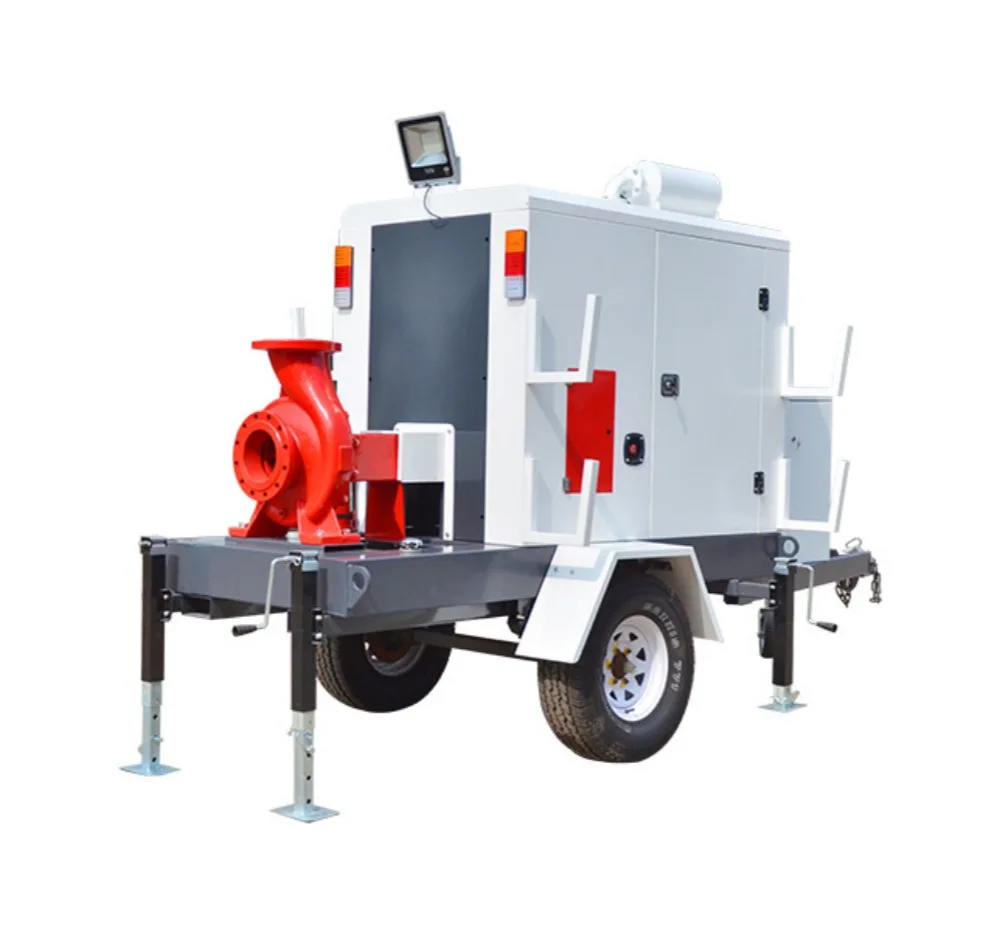
Centrifugal diesel drivendewatering pumps openframe trailer
The Centrifugal Diesel Driven Dewatering Pumps Open Frame Trailer Series is a high-mobility heavy-duty pump unit purpose-built for large-flow dewatering scenarios. Leveraging the lightweight structure of an open-frame trailer, it balances exceptional terrain passability with high drainage efficiency. This series requires no complex on-site infrastructure and can be rapidly put into operation, making it a core workhorse for flood control & drainage, agricultural irrigation, and construction site dewatering applications.
Introduction and Purpose
A centrifugal diesel‑driven dewatering pump mounted on an open‑frame trailer is a rugged, self‑contained mobile pumping system purpose‑built for efficient water removal (dewatering) in challenging environments. It is the workhorse of construction sites, mining operations, agricultural fields, and municipal flood‑control fleets. Its primary mission is to rapidly evacuate accumulated groundwater, rainwater, or process water from excavations, pits, tunnels, low‑lying areas, and flooded infrastructure, thereby enabling safe, dry working conditions and preventing costly downtime or structural damage.
Unlike electrically powered stationary pumps, this unit is entirely independent of the electrical grid – a critical advantage in remote locations or during power outages. The open‑frame trailer configuration further enhances its utility by offering a lightweight, easily towable platform that provides unrestricted access to all mechanical components for quick servicing and field repairs.
Core System Components
The complete system is carefully engineered as an integrated assembly of four interdependent subsystems: The Centrifugal Pump
-
Type – Typically a single‑stage, end‑suction centrifugal pump, although some models may feature a self‑priming design or a trash‑handling impeller (semi‑open or vortex) to pass solids up to a certain diameter (e.g., 50–100 mm) without clogging.
-
Materials – Cast iron casing with bronze or stainless steel impeller for clean water; hardened wear‑resistant alloys or replaceable liners for abrasive slurries (sand, gravel, mud).
-
Performance – Flow rates generally range from 200 to over 5,000 L/min (50–1,300 GPM), with heads from 10 to 80 metres, depending on impeller trim and engine speed.
-
Priming system – Many units are equipped with an automatic vacuum priming pump or a built‑in self‑priming mechanism, allowing suction lift from open water sources (rivers, ponds, flooded basements) without manual filling of the suction hose.
Diesel Engine (Prime Mover)
-
Power rating – Typically between 15 kW and 200 kW (20–270 HP), selected to match the pump’s duty point at the optimal engine speed (usually 1,500–2,200 rpm).
-
Cooling – Air‑cooled or liquid‑cooled, with heavy‑duty radiators suitable for tropical or high‑ambient‑temperature conditions.
-
Starting system – Electric start with a maintenance‑free battery; some models include a recoil or hydraulic backup starter for emergencies.
-
Fuel system – Integrated fuel tank with capacities from 50 to 400 litres, providing 8–24 hours of continuous operation at full load. Diesel fuel offers high energy density, low fire risk, and global availability.
-
Exhaust and emissions – Mufflers and, where required, diesel particulate filters (DPF) or selective catalytic reduction (SCR) to meet local emission standards (EPA Tier 4, EU Stage V).
Open‑Frame Trailer
-
Chassis – A robust welded steel frame, often hot‑dip galvanised or powder‑coated for corrosion resistance, with integrated towbar (ring or ball coupling), jockey wheel, and adjustable stabiliser legs.
-
Suspension and axles – Leaf‑spring or torsion‑axle suspension with high‑speed road‑rated tyres (typically 13–16 inches), ensuring stable towing at highway speeds (up to 80–100 km/h).
-
Braking system – Overrun brakes (mechanical or hydraulic) or electric brakes, with a parking brake for safe stationary operation.
-
Open structure – Unlike enclosed vans, the open frame leaves all components fully visible and accessible. This design drastically reduces weight (improving fuel economy and towability), simplifies routine checks (oil, fuel, coolant, belt tensions), and allows rapid component replacement without dismantling body panels – a significant benefit in remote or harsh environments where service facilities are limited.
Control and Safety Systems
-
Control panel – Weatherproof enclosure with ignition switch, throttle control, emergency stop, and instrument gauges (engine oil pressure, coolant temperature, tachometer, hour meter, and fuel level).
-
Protection devices – Automatic shutdown upon low oil pressure, high coolant temperature, or overspeed to prevent catastrophic engine failure.
-
Optional remote monitoring – Telemetry modules for GPS tracking, real‑time performance data (flow, pressure, run hours), and alarm notifications sent via cellular or satellite networks.
which provides the necessary power to drive the pump.
Diesel Engine: The diesel engine provides the power needed to operate the centrifugal pump. It’s chosen for itsreliability and fuel efficiency, making it suitable for remote locations or areas with limited access to electricity.
Open Frame Trailer: The open frame trailer serves as the platform for the pump and engine. It typically haswheels, making it mobile and easy to transport to different locations as needed. The open frame design allowsfor easy access to the components and simplifies maintenance.
Suction and Discharge Hoses: The system will include hoses for both the suction (inlet) and discharge (outlet)sides of the pump. These hoses are used to draw water from the source (like a flooded area or well) and
discharge it to the desired location.
Control Panel: Many dewatering pumps come with a control panel that allows operators to start, stop, and
monitor the pump’s performance. This can include features like a digital display for monitoring pump speed,
pressure, and engine diagnostics.
Fuel Tank: The diesel engine requires a fuel source, and a built-in fuel tank is often incuded in the system. Thistank can vary in size, depending on the expected run time of the pump.
Safety Features: These pumps may come with safety features such as emergency shutdown switches, exhaust
spark arrestors, and protective guards around moving parts.
Download Datasheet