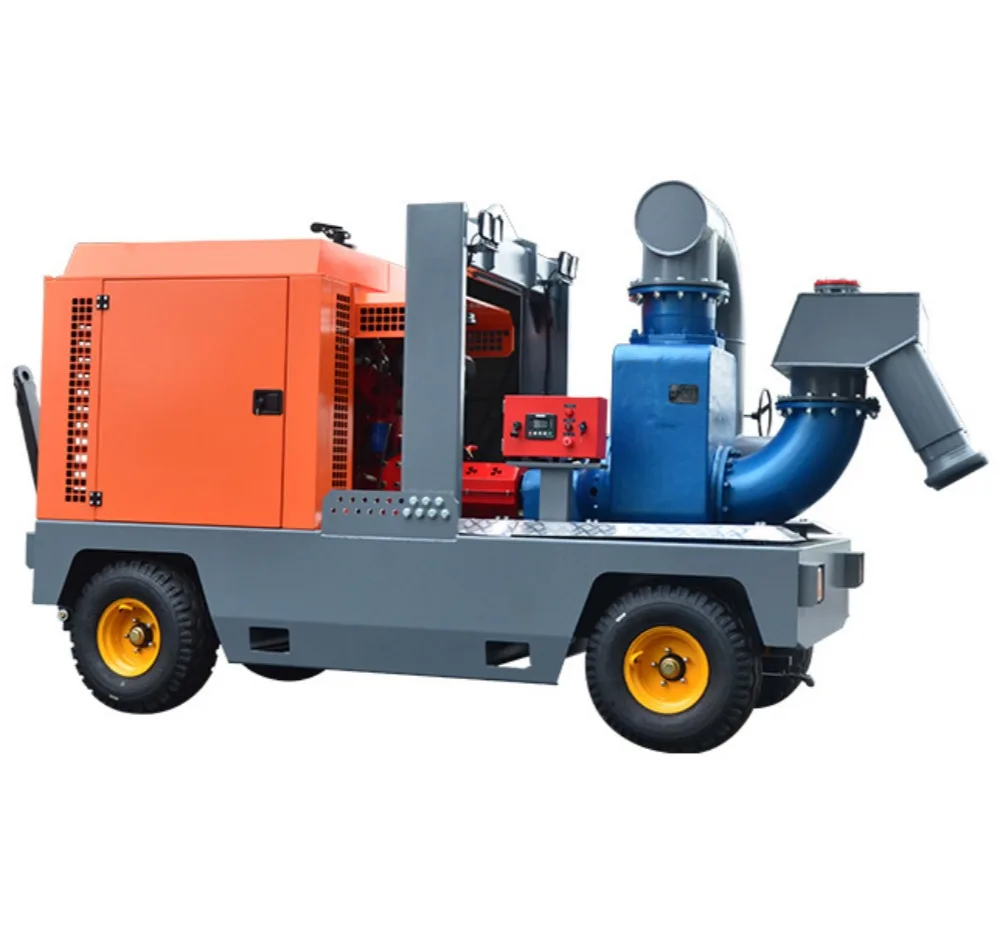
Pump Truck Self Priming Series Mobile
The Pump Truck Self Priming Series Mobile is a high-performance, trailer-mounted diesel pump unit designed for all-weather emergency drainage and water transfer operations. Built for mobility and reliability, it eliminates the need for pre-filling before startup, enabling rapid deployment to sites with complex water source conditions.
Core Components and System Architecture
A typical mobile pump truck comprises several interdependent subsystems, each carefully selected and arranged to optimise performance, reliability, and ease of use:
-
The Pump – The heart of the unit. Depending on the intended duty, the pump can be a centrifugal type (end‑suction, split‑case, or multi‑stage), a positive displacement pump (progressive cavity, gear, or piston), or a specialised submersible/trash pump. The choice dictates flow rate, pressure capability, solids‑handling capacity, and efficiency.
-
Power Source (Prime Mover) – Provides mechanical or electrical energy to drive the pump. Common options include:
-
Diesel engines – Favoured for off‑grid operations, offering high torque, fuel autonomy, and robustness in harsh environments.
-
Electric motors – Ideal for locations with reliable mains supply, delivering quieter operation, lower emissions, and reduced maintenance.
-
Hydraulic power units – Used when the pump is driven by a separate hydraulic system, often on heavy equipment.
-
Dual‑fuel or hybrid configurations – Combine an electric motor with a standby diesel engine for maximum redundancy in critical applications.
-
-
Control and Monitoring Panel – A centralised interface that manages start/stop sequences, speed regulation, pressure and flow monitoring, alarm annunciation, and remote telemetry. Modern panels feature PLC‑based logic, touchscreen displays, and IoT connectivity for real‑time data transmission to central control rooms or mobile devices.
-
Piping and Valving – Includes suction and discharge manifolds, isolation valves, check valves, pressure relief valves, and quick‑connect couplings (e.g., cam‑lock, Storz, or Victaulic) to facilitate swift hose attachment and detachment.
-
Chassis and Mobility System – A robust steel‑frame trailer or truck bed with axle(s), suspension, brakes, and highway‑rated tyres. Some units are skid‑mounted for crane lifting or containerised transport, while others are permanently installed on custom vehicles.
-
Enclosure and Weather Protection – A canopy or full cabin (typically constructed from galvanised or powder‑coated steel) shields the equipment from rain, dust, and extreme temperatures, ensuring reliable operation in all climates. Sound‑attenuating linings are available for noise‑sensitive environments.
Applications:
Construction Sites: Mobile pump trucks are commonly used for dewatering construction sites, especially when
dealing with excavation, foundation work, or underground construction.
Agriculture: They can be used for irrigation, transfering fertilizers, or managing water resources on farms.
Mining: In mining operations, mobile pump trucks are used for managing water levels in pits, transporting slurry,
and handling mine drainage.
Oil and Gas Industry: These units can transfer crude oil, manage drilling fluids, and handle wastewater in
oil and gas exploration and production.
Municipal Water Supply: Mobile pump trucks are deployed in municipal settings for temporary or
emergency water supply, such as firefighting or water main repairs.
Emergency Response: During natural disasters, such as floods or hurricanes, mobile pump trucks are
crucial for managing floodwater, drainage, and sewage bypass operations.
Industrial Processes: Various industries use mobile pump trucks to transfer fluids and manage processes,
such as chemical processing, food production, and pharmaceutical manufacturing.
Wastewater Management: These units are vital for moving and processing wastewater in municipal
treatment plants or industrial facilities.
Mobile pump trucks are valuable assets in industries where mobility, versatility, and rapid fluid transfer are
essential. They come in different sizes and configurations to suit specific applications, and their ease of transport
and operation makes them a practical solution for a wide range of fluid-handling tasks.
Download Datasheet